
8 July 2026
Download article [PDF]
What if the problem isn’t the capital – but the commercial assumptions we’re asking capital to finance?
If rare earths separation remains structurally uneconomic as market pricing evolves, are we solving a temporary financing problem?
Or are we trying to finance strategic capability using commercial assumptions that aren’t fit for purpose?
The challenge extends well beyond project finance.
Demand for demand’s sake is not a market.
Strategic capability emerges when supply, demand, pricing, capital and policy remain sufficiently coherent that the system can be sustained as conditions change across time.
That raises a different question entirely.
If the market alone cannot sustain capability that governments consider strategically necessary, what commercial model are we actually trying to build?
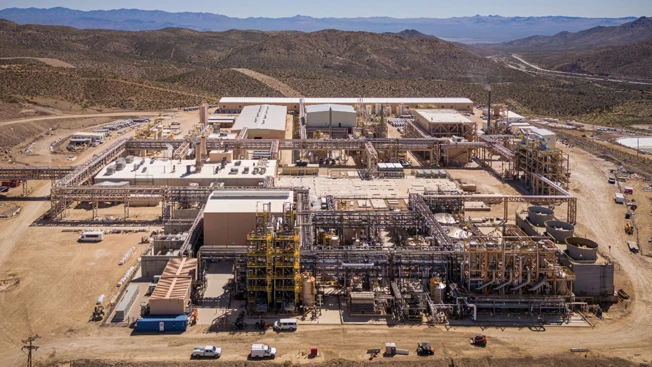
MP Materials’ rare earth mine in California – MP Materials
Rare earths are highlighting that the difficulty isn’t simply financing rare earth processing.
It’s sustaining processing capacity when the underlying operating economics remain structurally challenged.
If the value realised from separated rare earth products is insufficient to sustain the full cost of processing capacity, faster permitting, grants or cheaper debt do not solve the underlying commercial problem. They may finance construction but they don’t necessarily finance survival.
That’s why the MP Materials-US Department of Defense arrangement doesn’t simply provide capital.
It deliberately changes the commercial structure through a combination of:
- a price floor;
- government equity;
- debt; and
- long-term offtake.
Much current discussion assumes these mechanisms are temporary bridges until allied processing becomes commercially self-sustaining.
What if commercial self-sustainability remains elusive for much longer than most financing models assume?
That changes the question completely.
It is no longer:
How do we finance construction into production?
It becomes:
Can markets sustain strategic capability?
Traditional project finance expects repayment within a defined investment horizon.
Banks expect debt service.
Equity expects returns.
Private capital expects an exit.
If margins remain structurally inadequate, where does that repayment come from?
Who carries that risk?
Governments?
Producers?
Downstream manufacturers?
Customers?
Or some deliberate combination across the system?
We don’t expect a navy to become commercially self-sustaining.
We fund strategic capability because markets cannot fully price its value.
Its value isn’t measured by annual profitability.
Its value lies in knowing it exists when it is needed.
That doesn’t mean rare earth separation should simply become another permanently subsidised industry.
It does suggest we may be asking the wrong question.
If rare earths separation capability is genuinely strategic infrastructure rather than simply another industrial business, should it be financed using conventional project-finance assumptions at all?
Perhaps the challenge isn’t simply designing better funding mechanisms.
Perhaps we’re trying to finance strategic capability using commercial assumptions that don’t apply.
Or perhaps the deeper challenge is that we’re trying to solve a market problem before deciding what kind of market we’re actually trying to build.
The G7, FORGE, CMSR and similar initiatives all recognise the same underlying problem.
The market, as currently configured, is not producing the industrial capability governments now consider strategically necessary.
Their response is increasingly to reshape the market itself through pricing mechanisms, procurement, finance, standards and coordinated demand.
Market architecture is itself a geopolitical choice.
Every pricing mechanism, procurement framework and preferred partnership influences investment decisions, trade relationships and industrial geography.
The question therefore becomes:
What market are we actually designing – and what behaviours will it reward?
If strategic capability can survive only through ongoing public support, then pricing mechanisms have exposed the need for a more deliberate allocation of value, cost and responsibility across the system.
If that’s true, the conversation moves well beyond grants and loans.
It becomes a question of how governments, producers, capital providers and downstream customers deliberately allocate commercial, strategic and geopolitical risk across the system.
Not simply until the investment is repaid.
But until – and if – that capability becomes genuinely commercially self-sustaining.
If it ever does.
A coherent system does more than keep assets alive.
It brings capital, pricing, policy and demand around a shared purpose: building and sustaining the strategic capability when market signals alone can’t.
That suggests the unit of analysis may need to shift.
Rather than asking whether every mine or asset can achieve pay back and profitability, we may need to ask whether the supply chain as a whole creates the resilience society requires.
One part of the chain may generate strong returns.
Another may operate on structurally thinner or negative margins.
Yet their value is interdependent.
Together, they provide the continuity, optionality and strategic capability required to supply the materials that underpin the society we are not merely building for tomorrow, but already relying on today.
System coherence does not require every component to be equally profitable.
It requires the economics, obligations and benefits of the whole chain to be structured so that no strategically essential link is allowed to fail simply because its value is realised elsewhere in the system.
Rare earths may simply be a clear example. The broader question is whether we’re asking capital to finance strategic capability using assumptions developed for more conventional mining projects.
Capital can accelerate capability.
Pricing mechanisms can help stabilise it.
But neither, by themselves, creates a market.
Demand for demand’s sake is not a market.
Markets can be designed.
The question is whether we are designing the market deliberately.
And if that market is capable of sustaining the industrial capability we’re building.
References
MP Materials – DoD Partnership
European Critical Raw Materials Act
International Energy Agency
https://www.iea.org/reports/global-critical-minerals-outlook-2025
USGS Rare Earth Statistics
USGS Mineral Commodity Summaries
https://www.usgs.gov/publications/mineral-commodity-summaries-2026
Wood Mackenzie – Cost of expanding the rare earths supply chain
https://www.woodmac.com/reports/metals-cost-of-expanding-the-rare-earths-supply-chain-150165575
CSIS – Developing Rare Earth Processing Hubs: An Analytical Approach
https://www.csis.org/analysis/developing-rare-earth-processing-hubs-analytical-approach
Fritz, A.G., Tarka, T.J. & Mauter, M.S. Assessing the economic viability of unconventional rare earth element feedstocks. Nat Sustain 6, 1103–1112 (2023). https://doi.org/10.1038/s41893-023-01145-1