
23 April 2026
Download article [PDF]
Feasibility is interpretation.
Capital enables it.
Reality decides.
When a copper DFS requires a by-product streaming agreement to move into construction, the question may not be success – it may be whether the project can actually survive.
Capital does not fund projects to succeed.
It funds them to be repaid.
This article looks at where project feasibility meets capital – and how the economics are tested as capital commits.
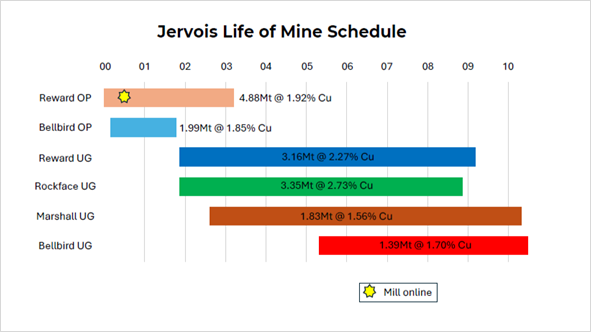
Modified after: KGL ASX release 10 February 2025 – Feasibility Study update
All mining projects are fragile. The question is where they fail – and how far that failure propagates through the economics, and whether the project slows, stalls, stops, survives or succeeds.
Feasibility is interpretation.
Capital enables it.
Reality decides.
KGL Resources has secured a US$300m streaming deal over the Jervois Project (NT), Australia.
On paper:
- JORC Resource: ~12–13 Mt @ ~2.8–3.0% Cu
- Ore Reserve: ~7–8 Mt @ ~2.7–3.0% Cu
- Underground mine with ~1.1–1.2 Mtpa processing plant
- ~10+ year mine life
- Permitting largely in place
- DFS-stage
Everyone knows the 2022 economics need updating – that’s not the story.
How Projects Actually Advance
Projects are not advanced on integrated facts. They are advanced on what is sufficient to proceed.
Each discipline passes on its own terms – geology, metallurgy, engineering, approvals, legal and financial. This is how projects are built – and why they are fragile. If the project passes, it doesn’t mean the studies and models are guaranteed to convert into a profitable operating mine under real conditions.
The physical system is fixed. Everything else is interpretation.
What a DFS Does – and Doesn’t Do
A DFS doesn’t remove risk. It standardises it within disciplines. And when conditions change – capital, cost, schedule, policy – the system re-prices the project in real time.
Streaming Is Not Optimisation
The Wheaton Precious Metals $300M deal is not purely project debt.
It is a gold and silver stream:
- US$275m upfront, plus US$25m contingency
- In exchange for:
- 75% of payable gold and silver initially
- Stepping down over time
- Delivered at ~20% of spot price
So:
- Copper remains the primary product
- But a significant portion of future Au/Ag value is sold forward
This is capital today, in exchange for reduced by-product value over life-of-mine. This is not optimisation.
This is converting uncertain future by-product value into certain capital today at the cost of future margin buffer.
Cost Structure: Where Reality Sits
Because C1 includes by-product credits. Most commentary stops at C1. That’s not where projects are financed.
From KGL’s disclosures: 2025 feasibility update:
‐ C1: ~US$1.95/lb Cu (steady state)
‐ AISC: ~US$2.86/lb Cu
‐ Construction capital: ~A$362m
‐ Peak funding requirement: ~A$498m
Earlier DFS (2022) showed:
‐ Total site operating cost ~US$2.22/lb
‐ Transport + smelting ~US$0.51/lb
‐ By-product credit ~(-US$0.51/lb)
‐ Resulting C1 ~US$2.22/lb
‐ AISC ~US$3.13/lb
From C1 to Full Economic Reality
The actual ladder looks like this:
C1 (~US$1.9–2.2/lb) – direct operating cost after by-product credits
AISC (~US$2.8–3.1/lb) – includes sustaining capital, royalties, ongoing burden
Full project break-even (>AISC) – includes:
- initial capex recovery
- financing structure (including streaming)
- schedule delays
- ramp-up inefficiencies
- working capital
That is the level capital is underwriting.
What Has Changed Since 2022
The DFS assumptions were built in a different environment:
- Capex ~A$220–250m
- Lower labour and contractor rates
- Lower diesel and logistics costs
- Tighter execution schedule
2026 reality:
- Capex now ~A$362m with ~A$498m peak funding
- Operating costs structurally higher
- Remote NT logistics remain a constant drag
- Schedule risk materially higher
The margin hasn’t disappeared. But the buffer has.
Where the Margin Went
C1 includes by-product credits. But:
- Gold and silver only contributed ~11% of gross revenue in the DFS
- A large portion of that is now streamed at ~20% of spot
So:
- The project keeps producing gold and silver
- But captures far less of their value
Which means: The effective cost of producing copper increases.
The Feasibility Corridor
This is a project moving through the feasibility corridor in real time.
The DFS was complete and updates are straight-forward But funding now tightens under:
- capital intensity
- cost escalation
- execution risk
So the structure changes:
- By-products monetised upfront
- Funding staged and conditional
- Economics rebuilt under capital scrutiny
From Analysis to Position
At some point this stops being analysis. It becomes position.
Proceed
Pause
Restructure
Walk away
Capital is not underwriting success. It is underwriting whether the system can survive the economics.
Project States: How Outcomes Actually Occur
From here, the project does not follow a single path.
There are several states:
- slow – delay, drift, pressure builds
- stall – no forward momentum
- stop – care & maintenance
- survive – continues, but tight
- succeed – delivers economic returns
These are not theoretical. The state persists until the system or capital force transition.
What Capital Is Actually Underwriting
Not success. Not perfection. A position above survival – where the project can absorb deviation and still repay the capital stack.
Failure Propagation Pathway
At Jervois, the dominant pathway is:
capex pressure → funding strain → schedule delay → cost escalation → margin compression
If it propagates early: the project stalls or stops.
If contained: the project survives.
Where Jervois Can Still Win
The upside is alignment:
- copper price holds
- capex stays within tolerance
- ramp-up stabilises
- cost drift is controlled
Small wins compound. Just like failures do.
The Real Threshold
A project doesn’t fail because risk exists. It fails when the economics can’t absorb how that risk propagates.
So if a copper project at this stage requires a by-product streaming agreement to move into construction, the question is not about this project. The question is what happens to projects that don’t have that option.
Copper projects often carry gold. Those credits can be sold forward.
Critical minerals usually don’t. They are less liquid, less understood, and dependent on markets that are still forming.
If capital requires this structure for copper, what is it going to require to complete the energy transition?
Conclusion
Projects move forward on the condition that capital accepts the risk of holding above failure long enough to be repaid.
That’s the threshold.
References
KGL – 2025 Feasibility Update
https://company-announcements.afr.com/asx/kgl/868489b5-fa15-11ef-9ad2-9673c0dd99c7.pdf
KGL – 2022 DFS
https://company-announcements.afr.com/asx/kgl/ed2ccb6a-64b4-11ed-b08b-9e133708e919.pdf
Wheaton Streaming Deal
Media Summary